Overview
OceanCanada Cross-Cutting Themes Created (2016)
A key objective of the OceanCanada partnership is to integrate knowledge across academics, community stakeholders, and organizations (private and public sectors) and offer a new avenue for data sharing, cross-fertilization of ideas, co-creation of knowledge, and collaborative building of research and governance capacity for the benefit of both current and future generations of Canadians. At our May 2016 conference, OceanCanada members devoted much time to devising plans to integrate the research of our existing Working Groups: Atlantic, Pacific, and Arctic (regional); and National Data and Integrated Scenarios, Law and Policy, and Knowledge Mobilization (national). Three new cross-cutting themes (CCTs) were created at this meeting – Access to Resources, Governance, and Changing Oceans, all in the context of ocean health and community wellbeing. Since our May conference, we have been working hard to advance the work of all groups to provide a more integrated approach to issues related to OceanCanada’s mandate. The integrative and cross-cutting nature of these themes is captured in the OceanCanada Partnership roof. As depicted in this figure, the goal is to conduct research that cuts across scales and Working Groups.
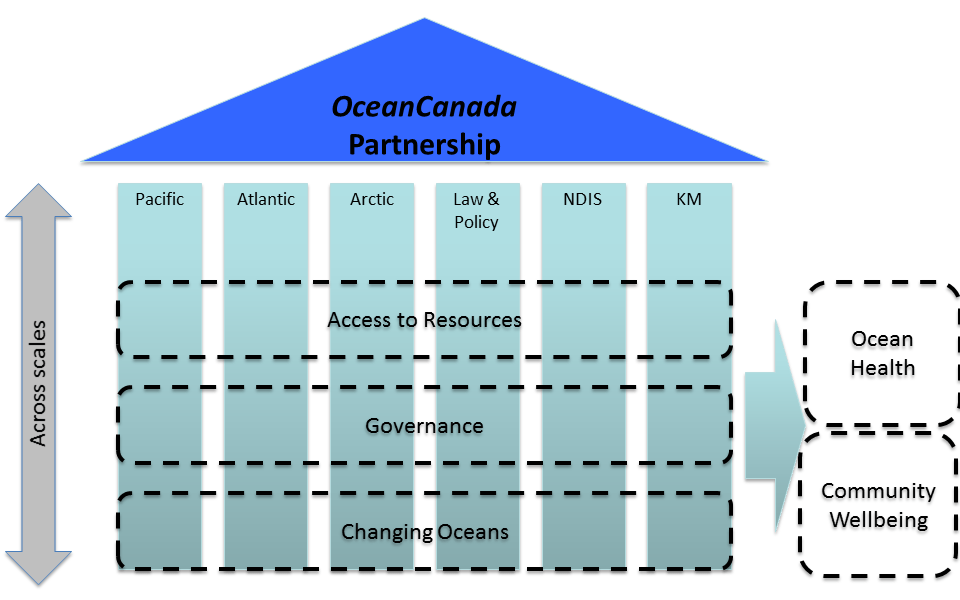 Integrating Regional and National research through Cross-Cutting Themes
Structure
Each cross-cutting theme (CCT) has a coordinator who works with OceanCanada Director Rashid Sumaila to develop integrative projects, and draw people and resources from across the OceanCanada membership to execute the identified projects. Megan Bailey, CRC in Integrated Ocean and Coastal Governance at Dalhousie University, coordinates the Access to Resources CCT; Carie Hoover, Postdoctoral Fellow at the Centre for Earth Observation Science, University of Manitoba, leads the Governance CCT; and the Changing Oceans CCT is headed by William Cheung, Director of Science for the Nereus Program, University of British Columbia. The first project for the cross-cutting themes is to develop a workshop on the three themes leading to one or more publications that integrate the regional and national groups’ existing research. Work has begun on this initiative with teleconferencing and the hiring of research assistants. Together with the OceanCanada Director, theme coordinators will inspire, stimulate, and motivate all OceanCanada members to actively engage in cross-cutting and integrative work that meets the goals of OceanCanada.
Cross-Cutting Themes
Access to Resources
In collaboration with researchers from the three regions (Arctic, Atlantic, Pacific), we are describing, analyzing, and thus moving forward the access imperative in Canadian fisheries using case studies to ascertain how access to marine resources and ocean spaces impacts community well-being. The group held a workshop on the topic from June 8 to 9, 2017 at UBC.
Theme Coordinators

Megan Bailey
Dalhousie University — Co-lead of Access Cross-Cutting Theme
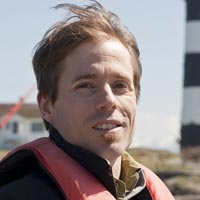
Nathan Bennett
University of British Columbia — Co-lead of Access Cross-Cutting Theme
Changing Oceans
We are conducting a series of interrelated research projects that includes OceanCanada members from all WGs to investigate:
- quantification of contributions of coastal habitats and resources to current and past community well-being;
- changes in ocean and socio-economic drivers in Canada under global change;
- effects of changing oceans on coastal habitats and resources;
- socio-economic, policy and governance responses to changing habitats and resources; (v) future of coastal community well-being under global change; (vi) development of conceptual models to explore high-level health and ocean health linkages.
Theme Coordinator

William Cheung
University of British Columbia — Lead of Changing Oceans Cross-Cutting Theme
Governance
We are taking stock of fisheries governance systems to assess strengths and weaknesses, through:
- compiling success stories of governance systems in Canada to address what types of governance structures exist;
- reviewing examples of adaptive governance and their contributions to well-being.
Theme Coordinators
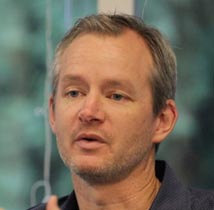
Derek Armitage
University of Waterloo — Co-lead of Governance Cross-Cutting Theme
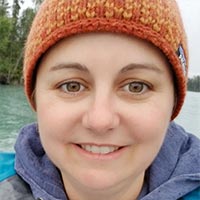
Carie Hoover
Dalhousie University — Co-lead of Governance Cross-Cutting Theme