Law and Policy
The Law and Policy Working Group, based at Dalhousie University, is studying the current state of Canada's law and policy frameworks in critical sectors affecting the management of our oceans, with a view to strengthening a principled approach to these legal and policy structures. Legal principles of sustainable development can be made the "foundation stones" for supporting healthy social-ecological systems, and we employ this perspective in all aspects of our work. Our Working Group is evaluating national fisheries law and policy frameworks, in light of sustainability principles, in order to better understand Canadian approaches to, and challenges faced in, seeking principled governance in the fisheries sector. Canada's law and policy approaches to and challenges in the growing field of aquaculture are also being assessed by members of our team, and compared to international experiences, with a view to the future development of a coherent legislative approach to the sector. Regional case studies are being carried out to assess the extent to which sustainability principles have been implemented, and where they may be more forcefully advanced. In addition to our formal SSHRC partners, the Canadian Fisheries Network and the Jebsen Institute (Tromsø, Norway) are informal associates of the Law and Policy Working Group.
Anticipated outcomes
- Assessments of the current state of implementation of sustainability principles in the Canadian legal and policy frameworks applicable to integrated ocean management, fisheries management and aquaculture
- Comparative studies to evaluate best practices internationally, and their potential applicability in the Canadian context
- Scenarios for future development and enhancement of sustainable approaches to ocean governance
- Directed policy advice for provision to federal, provincial and territorial governments in the legislative implementation of the results of these studies
- Training for graduate students in law and policy frameworks for sustainable ocean governance
Activities 2019-2020
Research efforts were focused on two projects. First, substantial progress was achieved in the project "Transboundary Fisheries Governance in an Era of Changing Oceans." A panel session was organized at the Integrated Marine Biosphere Research (IMBeR) Open Science Conference in Brest, France, 19-21 June 2019 where project papers were presented to an international and interdisciplinary audience. These papers were submitted to a special issue of Ecology and Society and have been accepted after peer review. The fourth and final paper is expected to be submitted before the end of April. Olga Koubrak and Cecilia Engler continued as HQPs/research assistants on the project. A second research focus was writing a chapter "Are Canadian Ocean Laws and Policies Climate Ready? Progressions and Challenges" as a contribution to the OceanCanada book publication with UBC Press. The co-authored chapter by Cecilia Engler, Phillip Saunders and David VanderZwaag was submitted in February. Professor Saunders has also contributed a further co-authored chapter from a law and policy perspective on the topic of access to Canadian fisheries.
Activities 2018-2019
Research and planning continued on the project, "Transboundary Fisheries Governance in an Era of Changing Oceans" (in cooperation with NDIS). A panel session has been accepted for the Integrated Marine Biosphere Research (IMBeR) Open Science Conference in Brest France, 19-21 June 2019 where project papers will be presented. Papers are expected to be finalized by mid-July with submission to a special issue of Ecology and Society due in September. Olga Koubrak and Cecilia Engler continued as HQP/research assistants on the project. The Law and Policy working Group co-organized an international conference, "Changing and Dynamic Oceans: Gauging Law and Policy Responses" at George Washington University Law School, 9-10 November 2018. In collaboration with the Environmental Law Institute, Oceana, NOAA and the GW Law School, the conference brought together leading law and policy experts and practitioners to address the challenges of managing offshore renewable energy and oil and gas developments, international fisheries conservation, marine mammal protection, deep seabed mining and the conservation of marine biodiversity beyond national jurisdiction. MELAW hosted the OceanCanada Conference in August 2018 (August 27-30). MELAW staff provided local coordination and logistics assistance under the direction of HQ staff.
Activities 2017-2018
Law and Policy activities have largely centred on conference presentations and continuing research and planning in preparation for nine articles for the project "Transboundary Fisheries Governance in an Era of Changing Oceans" (in cooperation with NDIS). In February 2018, Central hosted a workshop at UBC on the development of the special issue for this project. Two doctoral students have continued as HQP Research Assistants in the project, and they participated in a panel session, presenting project results to date, at the MARE Conference in Amsterdam in July 2017. Their participation in the conference panel was supported by an additional contribution of over $7,000 from Dalhousie-Schulich School of Law. In addition, one JD student was employed as a summer research assistant in support of this work and the Principled Fisheries Governance component in general. Planning continued for an Oceans Law and Policy Conference to be held at George Washington Law School in November 2018. In collaboration with the Environmental Law Institute, Oceana, National Oceanic and Atmospheric Administration (NOAA) and the GW Law School, the conference will bring together leading law and policy experts and practitioners to address the challenges of managing offshore renewable energy and oil and gas developments, international fisheries conservation, marine mammal protection, deep seabed mining and the conservation of marine biodiversity beyond national jurisdiction. The Marine and Environmental Law Institute (MELAW) at the Schulich School of Law will host the next OceanCanada Conference in August 2018. Liaison with Central has been maintained, and MELAW staff have provided local coordination and logistics assistance, as required and under the direction of Central staff.
Activities 2016-2017
The Law and Policy Working Group contributed to an edited collection titled Aquaculture law and policy: global, regional and national perspectives. A workshop on Integrated Fisheries Management Planning was held in Halifax in May 2016, with participation from members of other WGs and partner organizations, and plans were discussed for the next stage of this project. Student research on the IFMP project continued over the summer and has been reviewed. Three journal articles were completed and published, a further yearbook chapter was accepted for publication, and a number of presentations were delivered by faculty and students. We also began a new activity under fisheries law and governance: Transboundary fisheries governance in an era of changing oceans, and a cross-WG conference panel presentation and special journal edition are planned as part of this initiative.
Activities 2015-2016
During 2015/2016, the Law and Policy Working Group focused on the Aquaculture and Fisheries Law and Governance components. In Aquaculture, a workshop and publications, both in cooperation with the K. G. Jebsen Centre for the Law of the Sea at the University of Tromsø, proceeded on or ahead of schedule. The Fisheries Law and Governance component held a workshop with representatives of other OceanCanada Working Groups as well as partners, and work proceeded on initial publications. Further cooperation and cross-disciplinary contacts were pursued with the Canadian Fisheries Research Network (CFRN) and OCP partners, which will be developed in an upcoming workshop to refine and plan research outputs. Contact was made with OceanCanada Working Groups on possible cooperative work, and this will be pursued in the first six months of 2016/2017. The Integrated Governance component had no outputs planned for this period (although related outputs were completed), but initial work suggested some possible challenges to its current structure, in particular in ensuring interest and full input from other _OceanCanada_Working Groups.
Investigators
- Phillip Saunders (Co-Lead), Dalhousie University
- David VanderZwaag (Co-Lead), Dalhousie University
- Karen Hunter, Fisheries and Oceans Canada
- Robert Stephenson, Fisheries and Oceans Canada
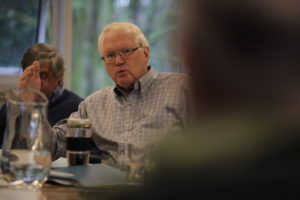
David VanderZwaag
David VanderZwaag, Dalhousie University
Highly Qualified Personnel
- Cecilia Engler — Assessing the adequacy of legal and policy frameworks to enable adaptive management in changing marine ecosystems, with particular focus on transboundary fisheries management and aquaculture management.
- Olga Koubrak — Determining if transboundary fisheries management arrangements in the North Pacific are seaworthy in a changing ocean.
Presentations
See Presentations
Partners
 Dalhousie University
 WWF-Canada
 Fisheries and Oceans Canada
 Saint Mary's University