Atlantic Region
The Atlantic Working Group operates out of the University of Waterloo and Saint Mary's University, and is addressing critical knowledge gaps, contributing methodologically innovative strategies for ocean and coastal planning, and developing policy insights about pressing regional concerns. One of our key projects is to use participatory modelling and scenario building to assess development, governance and stewardship options in collaboration with the community of Port Mouton, Nova Scotia. Models and scenarios are being used to explore specific economic development and environmental conservation options, including exploration of interactions between economic sectors, such as fisheries, tourism, and mineral extraction. We are examining the impact of a range of climate change scenarios, and possible human responses. We are also conducting a regional-scale assessment to identify the relationships among core marine ecosystem services (the benefits people derive from nature through provisioning, regulating, supporting and cultural functions), the material, relational and subjective wellbeing of coastal communities, and the experience with rapid changes (i.e., tipping points) in ocean and coastal systems. Members of our group are also undertaking an assessment and analysis of the governance mismatch between: a) local-provincial coastal management processes (e.g., provincial aquaculture policies, support for coastal community diversification) and ocean-related planning processes operating at federal levels; and b) the ability of existing institutions and governance arrangements at multiple scales to respond to rapid changes in social-ecological conditions (e.g., stock decline, stock shifts, acidification).
Anticipated outcomes
- Models and scenarios of coastal and ocean change and potential futures (socio-economic and biophysical) that can assist local and regional policy makers
- Potential transfer of participatory modeling approach to other sites in the Atlantic and to other regions
- Novel assessments of links among ocean and coastal ecosystem services and wellbeing in the context of rapid change to support coastal communities and guide policy makers
- Strategies to improve coordination among local, provincial and federal actors in oceans planning and management
- Building capacity and training of students to tackle transdisciplinary ocean challenges
Activities
Details
Activities 2019-2020
No major changes in activity or team since the previous report. Main activities are ongoing HQP initiatives. Stamness completed her MES. Andrews and Eger are both in the writing stage of their PhDs. A new doctoral student at UW (Ella-Kari Muhl) was involved in OCP-related activities as her research is taking place in marine governance in Haida Gwaii, British Columbia. A key focus has been on completing the OCP book project and synthesis involving numerous HQP. Overall, the Atlantic Working Group has continued to foster applied research to help government agencies, communities, and other partners manage the increasing change and uncertainty associated with ocean and coastal systems (ecological, social and institutional). In doing so, we are progressing on several fronts: 1) addressing key knowledge gaps about social-ecological change in ocean and coastal systems, and the implications for the wellbeing and resilience of coastal communities in the Atlantic region; 2) contributing methodologically innovative strategies for ocean and coastal planning; and 3) to develop insights to support more adaptive policy and governance for issues of regional concern. A more complete list of activities and initiatives is described. AWG team includes the following individuals that have participated in some manner with working group initiatives over the life of the project:Details
Activities 2018-2019
The Atlantic WG is continuing work from previous years with no new projects initiated.Details
Activities 2017-2018
The Atlantic WG is continuing to foster applied research to help government agencies, communities, and other partners manage the increasing change and uncertainty associated with ocean and coastal systems (ecological, social and institutional). In doing so, it is progressing on several fronts: 1) addressing key knowledge gaps about social-ecological change in ocean and coastal systems, and the implications for the wellbeing and resilience of coastal communities in the Atlantic region; 2) contributing methodologically innovative strategies for ocean and coastal planning; and 3) developing insights to support more adaptive policy and governance for issues of regional concern. Key areas of progress include HQP developing research projects, formalized arrangements with new partners, engagement in new initiatives related to core OceanCanada themes (e.g., taking stock, developing scenarios), on-going development of previously identified initiatives, and engagement with postdoctoral fellows to support aspects of the WG research plan. A significant component of activities over the past year has been to catalyse and implement initiatives to support the Governance cross-cutting theme, and provide support where possible to other cross-cutting theme activities.Details
Activities 2016-2017
The following is a small sample of the major activities undertaken by the Atlantic Working Group over 2016/2017. Our graduate students and postdoctoral researchers were active on several fronts related to regional assessment activities, including undertaking field research in Newfoundland in a study of the shrimp fishery, a project on marine spatial planning in the Atlantic region, and fieldwork involving community perspectives on MPAs and community wellbeing. Our bowtie analysis of cumulative effects in the Northumberland Strait was completed, and we continue to assess the precision and accuracy of the Community Aquatic Monitoring Program (CAMP) in describing littoral nekton assemblages of estuaries within the southern Gulf of St. Lawrence. Our partner, Friends of Port Mouton Bay, is working on a Nitrogen Loading Model paper with a focus on developing a model framework for estimating nitrogen loading from background sources and coastal fish-farm aquaculture. Eelgrass monitoring in Port Mouton Bay also continued under the protocols of SeaGrassNET, a Global Sea Grass Monitoring Network, co-sponsored by the Southern Gulf of St. Lawrence Coalition on Sustainability. We made progress on the development of local scenarios for the community of Port Mouton, Nova Scotia. We are also examining the extent to which Nova Scotia coastal communities are engaging in future planning, and continue to undertake a systematic review of coastal community climate change adaptation. We hosted a Governance Cross-Cutting Theme meeting in at the University of Waterloo in November 2016 to chart a path forward. Subsequently, we convened a workshop in March 2017 on rapid coastal change and governance at University of Waterloo. Graduate students and postdoctoral researchers developed an expert survey regarding the governance of Canada's oceans along with several webinars. Data collected from these activities will be used in publications.Details
Activities 2015-2016
The Atlantic Working Group continued to foster applied research to help government agencies, communities, and other partners manage the increasing change and uncertainty associated with ocean and coastal systems (ecological, social and institutional). It progressed on several fronts: 1) addressing key knowledge gaps about social-ecological change in ocean and coastal systems, and the implications for the wellbeing and resilience of coastal communities in the Atlantic region; 2) contributing methodologically innovative strategies for ocean and coastal planning; and 3) developing insights to support more adaptive policy and governance for issues of regional concern. Key areas of progress were in the areas of graduate student research projects, formalized arrangements with new partners, engagement in new initiatives related to core OCP themes, on-going development of previously identified initiatives, and recruitment of a post-doctoral fellow to support aspects of its research plan.Investigators
- Derek Armitage (Lead), University of Waterloo
- Tony Charles, Saint Mary's University
- Ratana Chuenpagdee, Memorial University
- Simon Courtenay, University of Waterloo
- Ron Loucks, Friends of Port Mouton Bay
- Prateep Nayak, University of Waterloo
- Robert Ross, Friends of Port Mouton Bay
- Ruth Smith, Friends of Port Mouton Bay
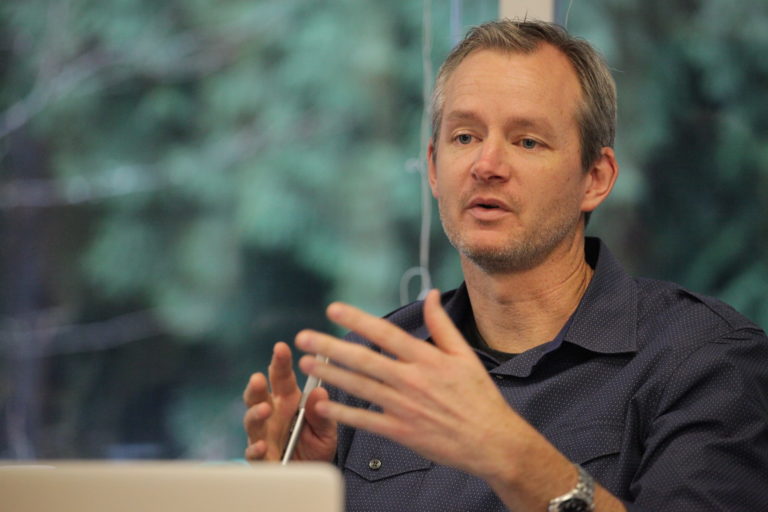
Dr. Derek Armitage
Dr. Derek Armitage
Highly Qualified Personnel
- Irene Brueckner-Irwin — Studying the implications of marine protected areas on social-ecological wellbeing in the Bay of Fundy, Canada.
- Libby Dean — Investigating community-based approaches to explore environmental issues and topics.
- Sondra Eger — Examining past and current ICOM initiatives in Atlantic Canada and the role played by communities in implementing ICOM initiatives.
- Shannon Hicks — Identifying effective ways to simultaneously address issues relating to poverty and climate change adaptation at the community level.
- Ella-Kari Muhl — Focusing on knowledge co-production and collaborative forms of marine conservation and governance in Canada (Pacific/Haida Gwaii) and South Africa.
- Rebecca Zimmerman — Research largely focusing on community engagement in coastal future planning.
Presentations
Presentations by the Atlantic Working Group are listed in the project data (tables/6-Presentations-Atlantic-2026-02-09.csv).
Partners
 Canadian Rivers Institute
 Friends of Port Mouton Bay
 Dalhousie University
 Saint Mary's University
 Fisheries and Oceans Canada
 University of Waterloo