Pacific Region
The Pacific Working Group, based at the University of Victoria and the University of British Columbia, is studying human well-being in the face of social-ecological change in Canada's Pacific Ocean coastal communities. Members of our Working Group have partnered with local communities to conduct policy-relevant research on social-ecological interactions in coastal ocean areas to support marine spatial planning. Research themes include assessing social values of community and coastal resource users and understanding the impacts of climate change on biodiversity and ecosystem valuation. Collectively, our research is generating a better understanding of the socio-cultural, economic and ecological challenges facing coastal communities. We are linking with industry stakeholders and integrating academic research with on-the-ground adaptive management. In addition to our formal SSHRC partners, Port Metro Vancouver is a project collaborator, and Vancouver Island University is an informal associate of the Pacific Working Group.
Activities 2019-2020
In the past year, our main activities have continued to focus on supporting work on the topic of access through the work of post-doctoral fellow Dr. Nathan Bennett, and by supporting the access cross-cutting theme. With partner T. Buck Suzuki Foundation and numerous collaborators, we worked with two Mitacs interns (Dacotah Splichalova and Anna Schubauer) to develop and implement a survey about access and well-being of owner-operator commercial fishers in BC. We obtained more than 100 responses throughout the province, carried out initial analyses, and communicated the findings to several fisher forums. Reports and manuscripts are being prepared from the results of these surveys. The small grants we provided to students during the first half of OCB in the Pacific region continue to bring research to fruition. In particular, two PhD students, Rachelle Beveridge and Charlotte Whitney, finished PhD research and dissertations. We are also supporting several new HQP to complete publications on topics pertinent to the OceanCanada Partnership.
Activities 2018-2019
In the past year, the main activities of the Pacific WG have continued to mainly focus on supporting work on the topic of access through the work of post-doctoral fellow Dr. Nathan Bennett. While several of the smaller projects of past years have been completed, progress on analysis, writing, outreach and publishing the results from them continues. In particular, two of our HQP (Rachelle Beveridge and Charlotte Whitney) have continued to advance their PhD research and dissertations, and several other members (Edward Gregr and Tom Okey) have published recent papers stemming from their work. We will also be hosting a final workshop focused on MPAs involving members of the Pacific WG. Many members of the Pacific WG attended the OceanCanada annual conference in Halifax in August 2018, as did our NGO partner, Ecotrust Canada, who has likewise focused on the theme of access within the context of community well-being. They completed the multi-year report "Just Transactions, Just Transitions" and published the Proceedings Report from the 2018 Fisheries for Communities Gathering. They continued to bring forward issues around, and barriers to, access in forums and presentations.
Activities 2017-2018
This past year, the Pacific WG has focused its efforts and funding on supporting the Access cross-cutting theme in two ways: by providing partial funding support for a postdoctoral fellowship for Nathan Bennett, and by supporting the workshop that the Access CCT held in Vancouver in June 2017, and research and a workshop co-hosted by Natalie Ban on the social impacts of MPAs. Progress also continues on small projects by WG members. A few examples include:
- a survey questionnaire, sampling plan, and data analysis plan on purchasing seafood in selected Canadian cities to measure consumer preferences related to certain seafood features. The main objective of the survey will be to contribute to assessing the market feasibility of developing and growing alternative seafood businesses in BC and elsewhere in Canada;
- continued work on issues of access, community well-being, and fishermen and community viability. A key milestone was the convening of fisheries and community stakeholders on Pacific access issues;
- understanding the effects of sea otter reestablishment on ecosystem service benefits derived by coastal communities on the west coast of Vancouver Island;
- continued coordination of the Local Environmental Observer (LEO) Network in Coastal British Columbia (leonetwork.org), which is enabling diverse knowledge holders to share observations of unusual environmental change.
Activities 2016-2017
This year, the Pacific Working Group made steady progress with ongoing projects which began to yield results, presentations and publications. Our approach has been to support projects and case studies that advance OceanCanada themes. We supported three new projects in 2016/2017, and others continued. Combined, these projects illustrate the diversity of perspectives and topics related to the oceans in BC, and provide a richness of case studies for future OceanCanada-wide integrative activities. We explored opportunities for linking with the three Cross-Cutting Themes and facilitating more integrative thinking at larger scales. More specifically, we did preliminary work to organize an Access Cross-Cutting Theme workshop for June 2017. Our research activities have been in the following areas:
- marine community support for conservation;
- effects of sea otter reestablishment on the ecosystem in communities on the west coast of Vancouver Island;
- loss, recovery and stewardship of eulachon on the central Pacific coast of BC;
- local benefits from seafood value chains in BC coastal communities;
- ecological indicators, expert perceptions, and local observations;
- assessing changes in rockfish size and distribution for conservation strategies;
- moving from assessment to action on adaptive capacity.
Activities 2015-2016
The Pacific Working Group continued to support graduate student projects that involve local communities and industry stakeholders in conducting policy-relevant research investigating human well-being in the face of social-ecological change in Pacific coastal communities. It provided research funds to students through two calls for proposals. One of the funded projects resulted in two graduate students hosting a workshop in November 2015 on adaptive capacity which led to a publication relevant to the broader OceanCanada partnership. In addition, Working Group members presented at various conferences and had numerous publications related to OCP objectives.
Investigators
- Natalie Ban (Co-Lead), University of Victoria (view video)
- Nathan Bennett (Co-Lead), University of British Columbia
- Dyhia Belhabib, Ecotrust
- Edward Gregr, University of British Columbia
- Tom Okey, University of Victoria
- Evelyn Pinkerton, Simon Fraser University
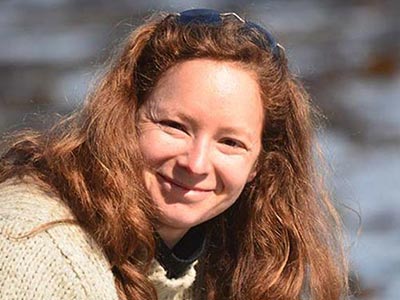
Dr. Natalie Ban
Dr. Natalie Ban: Pacific Working Group Co-Lead
Highly Qualified Personnel
- Nathan Bennett — Understanding coastal and Indigenous community access to marine resources and the ocean, governance and management of marine protected areas, and coastal community responses to combined environmental and social changes.
- Rachelle Beveridge — Loss and recovery of the eulachon: a case study of central coast stewardship priorities and perspectives.
- Charlotte Whitney — Measures of adaptive capacity for social-ecological systems in response to climate impacts.
Presentations
See Presentations
Partners
 Ecotrust Canada
 University of British Columbia
 Fisheries and Oceans Canada
 University of Victoria
 Simon Fraser University