Arctic Region
The Arctic Working Group, based at Carleton and McMaster universities, is working to connect current knowledge of key issues of concern to Arctic Ocean coastal communities to broad questions of science and policy integration. The group holds as a key goal the empowerment of community voices in the Arctic region and is currently establishing collaborative activities that can support this work.
Activities 2019-2020
The Geomatics and Cartographic Research Centre (GCRC) has continued to work actively developing its partnership with Arctic groups over the past year, and this has included negotiating and consolidating funding for on-going atlas maintenance and technological development work, and for training and development. Our key Northern partners include: Government of Nunavut, Nunavut Coastal Resource Inventory (NCRI), now Nunavut Coastal Inventory (NRI), which includes 22 communities, with whom a new Memorandum of Understanding with GCRC, Carleton University was developed, and funding secured (March 2020); and Several Northern Communities and Organizations including Chesterfield Inlet (where the OCP Atlas presentation at the 2018 conference resulted in the development of an atlas creation project), the Kitikmeot Heritage Society (KHS) of Cambridge Bay, Inuit Tapiriit Kanatami, Clyde River, Slave Lake Coalition, Savoonga/St. Lawrence Island, Nunavut Tunngavik Inc and Nunavut Research Institute. GCRC also secured considerable funding for its upcoming multi year cycle of work from the Canadian Foundation for Innovation (CFI) and from the Ontario Research Fund (ORF) to advance the work of the Canadian Consortium for Data Interoperability, including the further development of the Nunaliit Cybercartographic Atlas Framework, and addition of new functionalities; this will contribute to Northern environmental/water research. Its collaboration with other Carleton University partners as follows complements its Arctic work: Towards a Suitable Fishery for Nunavummiut (School of Public Policy and Administration); and Pilot Atlas of the Inuit Language in Canada (School of Linguistics and Language Studies). The Arctic Working Group worked actively on its contribution to the forthcoming OceansCanada book (2020), with Indigenous partners leading the research work plan; and actively supported the preparation for the planned (and now postponed) May 2020 Oceans Canada Partnership Conference in Ottawa. Two OCP book chapters of particular interest in terms of Arctic Working Group contributions, (Chapters 2 and 11), are currently in review. We look forward to the rescheduling of the 2020 Conference.
Activities 2018-2019
The Geomatics and Cartographic Research Centre (GCRC) at Carleton University has continued to work actively developing its partnership with Arctic groups over the past year, and this has included negotiating and consolidating funding for on-going atlas maintenance and technological development work, and for training and development. Our key Northern partners include Government of Nunavut; Nunavut Coastal Resource Inventory (now Nunavut Coastal Inventory), which includes 22 communities, with whom a new Memorandum of Understanding with GCRC, Carleton University has been developed and signed (March 2019); and several northern communities and organizations including the Kitikmeot Heritage Society of Cambridge Bay, Inuit Tapiriit Kanatami, Clyde River, Slave Lake Coalition, Sahtu and Gwich'in. GCRC participated in the OceanCanada Annual Conference in August 2018, and presented the Arctic Ocean Atlas. It conducted a Nunaliit training workshop with Kitikmeot Heritage Society and the Danish National Museum to develop the Fifth Thule Expedition Atlas in June 2018, this being part of a SSHRC International Partnership Development Grant approved in 2017. Mike Jaypoody of the Ittaq Heritage and Research Centre and Illisaqsvik Society launched the Clyde River Knowledge Atlas at the ArcticNet Conference in Ottawa in December 2018, and it is featured in a February 5, 2019 Nunatsiaq News article. Taylor, Hayes, and Oikle of the GCRC and Pulsifer of ELOKA (Exchange for Local Observations and Knowledge of the Arctic) supported the development of the atlas, and funders include TidesCanada, Crown-Indigenous Relations, and Northern Development Canada Indigenous Community-Based Climate Monitoring Program. The GCRC also secured considerable funding for its upcoming five-year cycle of work from the Canadian Foundation for Innovation (CFI) and from the Ontario Research Fund (ORF) to advance the work of the Canadian Consortium for Data Interoperability, including the further development of the Nunaliit Cybercartographic Atlas Framework, and addition of new functionalities. This will contribute to northern environmental/water research. Its collaboration with other Carleton University partners as follows complements its Arctic work: Towards a Suitable Fishery for Nunavummiut (School of Public Policy and Administration); and Pilot Atlas of the Inuit Language in Canada (School of Linguistics and Language Studies). The Arctic Working Group has also commenced work on its contribution to the forthcoming OceanCanada book (2020), with Indigenous partners leading the research work plan.
Activities 2017-2018
At Carleton University, the major contribution to the project over the past year was a new version of the Inuit Sea Ice (SIKU) Atlas. The Arctic WG has expanded the content of the Arctic Oceans Atlas to include two new components, an Inuit Place Names Atlas and a Nunavut Coastal Resource Inventory Atlas. Both of these, which are close to completion, require significant funding resources, and additional funding has been obtained from the Government of Nunavut, the Kitikmeot Heritage Society, and the Slave River Coalition. The WG been cooperating with Oceans North Canada who are completing a hard copy Atlas of the Arctic Ocean which should be published in spring 2018. The WG has provided hard copy versions of some of their maps for publication in that Atlas, and will be presenting both atlases at the OceanCanada 2018 Conference in Halifax. Several communities and organizations are providing community-based atlases to include as components of the Arctic Ocean Atlas. In September 2017 the WG brought them together in a three-day workshop to share experiences and explore possible new functionalities for Nunaliit. At McMaster University, the WG has made major advances in partnership building within its community-level project in Chesterfield Inlet. HQP Sarah Newell, David Kattigatsiak of Chesterfield Inlet, and WG co-lead Nancy Doubleday submitted a SSHRC Partnership Engage application for this project. The WG at McMaster has focused its efforts on two priorities: 1) adding to the fine-grained analysis of community-level experience of practical needs for participation in ocean management; and 2) the cultivation and training of HQP, achieved through field work in Chesterfield Inlet, and support of student research with the potential for contributing to OceanCanada's cross-cutting themes. Professor Chris Myrh, a communications specialist and digital artist, has joined the McMaster team.
Activities 2016-2017
At Carleton University, we were completing the cross-atlas layer sharing, and making good progress on the SIKU Atlas layers, which will present data in new formats and schemas. The Genome Canada Project (Towards a Sustainable Fishery in the Arctic) atlas is using the Nunavut Coastal Research Inventory (NCRI) data model. The Nunavut Place Names Atlas has now been renamed the Inuit Places Atlas and the scope has increased to include other regions. The atlas structure was set up and our partners at the Kitikmeot Heritage Society (KHS) will be reaching out to other Inuit Peoples in the Circumpolar Arctic. The Clyde River Atlas is now up and running. Work was underway on several models, including NCRI integration and community plans to enhance the atlas with video and audio interviews from Elders. At McMaster University, we participated in local-level social-ecological modelling, led by the Atlantic Working Group, and were moving to the Arctic implementation of the SES model-development strategy. Phase 1 of this initiative was completed, and we transferred our knowledge of fine-scale local level relationships to articulation of an Arctic site. We also collected metadata on trans-regional ocean globalization and implications for social-ecological systems. Research topics at Carleton during 2015/2016 were increasing partnerships for atlas expansion and development of a secondary data strategy for a metadata-base design. The Working Group was also involved in developing best practices for organizing ethics for research practices. The objectives are to have one or more studies exploring partnership building in the context of building an Arctic Ocean Atlas by expanding the existing SIKU Atlas and other projects of the Geomatics and Cartographic Research Centre (GCRC), and to develop a metadata-base design to be prepared as a model for OCP as a whole. At McMaster, with the engagement of a doctoral student in health policy, the Working Group advanced discussion of community-level case studies, and participated in cross-working group activities. Outputs included presentations, journal articles, and development of guidelines for conducting ethical research as well as a metadata-base design framework. The Working Group facilitated access to resources used in current and previous community engaged work for the benefit of the OceanCanada partnership.
Investigators
- Nancy Doubleday (Co-Lead), McMaster University
- D. R. Fraser Taylor (Co-Lead), Carleton University
- Amos Hayes, Carleton University
- Gita Ljubicic, Carleton University
- Rob Oikle, Carleton University
- Jason Wong, Carleton University
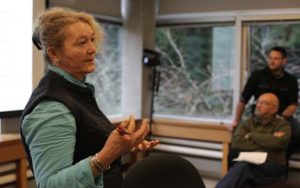
Dr. Nancy Doubleday
Dr. Nancy Doubleday: Arctic Working Group Co-Lead
Highly Qualified Personnel
- Zaynab Al-Hemed — Studying the implications of marine protected areas on social-ecological wellbeing in the Bay of Fundy, Canada.
- Romola Thumbadoo — Work with Dr. Fraser Taylor at the Geomatics and Cartographic Research Centre; PhD research on the work and legacy of Algonquin Elder William Commanda of the Ottawa River Watershed (completed January 2018).
Presentations
See Presentations
Partners
 Carleton University
 McMaster University