
16 posts tagged with "Coastal Communities"

View All Tags

The COVID-19 Pandemic, Small-Scale Fisheries and Coastal Fishing Communities

Brief

Download PDF

Abstract

The COVID-19 pandemic has rapidly spread around the world with extensive social and economic effects. This editorial focuses specifically on the implications of the pandemic for small-scale fishers, including marketing and processing aspects of the sector, and coastal fishing communities, drawing from news and reports from around the world. Negative consequences to date have included complete shut-downs of some fisheries, knock-on economic effects from market disruptions, increased health risks for fishers, processors and communities, additional implications for marginalized groups, exacerbated vulnerabilities to other social and environmental stressors, and increased Illegal, Unreported and Unregulated fishing. Though much of the news is dire, there have been some positive outcomes such as food sharing, the revival of local food networks, increases in local sales through direct marketing and deliveries, collective actions to safeguard rights, collaborations between communities and governments, and reduced fishing pressure in some places. While the crisis is still unfolding, there is an urgent need to coordinate, plan and implement effective short- and long-term responses. Thus, we urge governments, development organizations, NGOs, donors, the private sector, and researchers to rapidly mobilize in support of small-scale fishers, coastal fishing communities, and associated civil society organizations, and suggest actions that can be taken by each to help these groups respond to the COVID-19 pandemic.
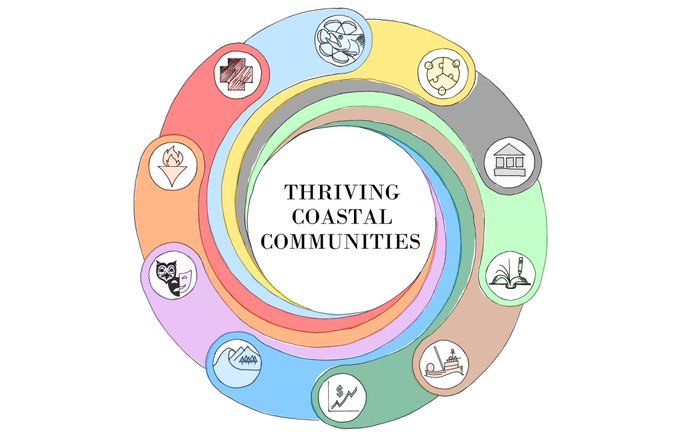
A new report titled “The Thriving Coastal Communities Initiative: Towards an action research agenda focused on well-being in coastal communities in British Columbia” has been produced in a group effort between T.Buck Suzuki Environmental Foundation and OceanCanada's Dr. Nathan Bennett, as well as a large team of collaborators. Support for convening the initial meeting at the University of British Columbia came from the Vancouver Foundation.

The Thriving Coastal Communities Initiative

Rural and resource-based coastal communities in British Columbia (BC) are facing a number of pressing challenges that are affecting the holistic health and well-being of local people. The challenges facing coastal communities include being disconnected from decision-making process, a changing climate, rapidly evolving ecosystems, increasing pollution, declining investment, loss of community infrastructure, increasing competition over marine space, loss of access to fisheries and increasingly complex marine management regimes. Local communities are feeling the impacts of these pressures and changes in very real ways. Research into communities on the BC coast suggests that they are experiencing loss of livelihoods, declining economies, outmigration of youth to urban centers, loss of food security, increasing drug use, and a suite of physical and mental health challenges. It is important that coastal communities continue to thrive and maintain an active presence on the water. Yet, change is a constant for coastal communities. The health and well-being, indeed the persistence, of coastal communities depends on their capacity to proactively respond to external change and challenge. The presence of thriving communities on the coast is also important for Canadian society - as coastal communities can strengthen rural-urban dynamics, support robust food systems and economies, be the eyes on the longest coastline in the world, be first responders in the case of emergencies, and be active stewards of the marine environment.

Coastal and Indigenous community access to marine resources and the ocean: a policy imperative for Canada.

Access, defined as the ability to use and benefit from available marine resources or areas of the ocean or coast, is important for the well-being and sustainability of coastal communities. In Canada, access to marine resources and ocean spaces is a significant issue for many coastal and Indigenous communities due to intensifying activity and competition in the marine environment. The general trend of loss of access has implications for these communities, and for Canadian society. In this review and policy perspective, we argue that access for coastal and Indigenous communities should be a priority consideration in all policies and decision-making processes related to fisheries and the ocean in Canada. This paper reviews how access affects the well-being of coastal communities, factors that support or undermine access, and research priorities to inform policy. Recommended actions include: ensuring access is transparently considered in all ocean-related decisions; supporting research to fill knowledge gaps on access to enable effective responses; making data accessible and including communities in decision-making that grants or restricts access to adjacent marine resources and spaces; ensuring updated laws, policies and planning processes explicitly incorporate access considerations; and, identifying and prioritizing actions to maintain and increase access. Taking action now could reverse the current trend and ensure that coastal and Indigenous communities thrive in the future. This is not just a Canadian issue. Globally, the ability of coastal and Indigenous communities to access and benefit from the marine environment should be at the forefront in all deliberations related to the oceans.

Adaptive capacity: from assessment to action in coastal social-ecological systems.

Concerns about the social consequences of conservation have spurred increased attention the monitoring and evaluation of the social impacts of conservation projects. This has resulted in a growing body of research that demonstrates how conservation can produce both positive and negative social, economic, cultural, health, and governance consequences for local communities. Yet, the results of social monitoring efforts are seldom applied to adaptively manage conservation projects. Greater attention is needed to incorporating the results of social impact assessments in long-term conservation management to minimize negative social consequences and maximize social benefits. We bring together insights from social impact assessment, adaptive management, social learning, knowledge coproduction, cross-scale governance, and environmental planning to propose a definition and framework for adaptive social impact management (ASIM). We define ASIM as the cyclical process of monitoring and adaptively managing social impacts over the life-span of an initiative through the 4 stages of profiling, learning, planning, and implementing. We outline 14 steps associated with the 4 stages of the ASIM cycle and provide guidance and potential methods for social-indicator development, predictive assessments of social impacts, monitoring and evaluation, communication of results, and identification and prioritization of management responses. Successful ASIM will be aided by engaging with best practices – including local engagement and collaboration in the process, transparent communication of results to stakeholders, collective deliberation on and choice of interventions, documentation of shared learning at the site level, and the scaling up of insights to inform higher-level conservation policies-to increase accountability, trust, and perceived legitimacy among stakeholders. The ASIM process is broadly applicable to conservation, environmental management, and development initiatives at various scales and in different contexts.

The big role of coastal communities and small-scale fishers in ocean conservation.

Around the world, many coastal communities and small-scale fishers have proven effective as stewards of their local marine environments and resources. Given these considerable successes, this chapter assesses opportunities to increase the focus in ocean conservation practice and policy on initiatives at the local level of coastal communities and small-scale fishers. The chapter reviews the historical evolution of ocean conservation, with a focus on fundamental shifts to more holistic approaches of ecosystem-based and integrated management, and to a greater focus on participatory governance. These major shifts reinforce the role in ocean conservation of local-level coastal communities and small-scale fishers. Drawing on case studies of the Community Conservation Research Network, the rationale for a focus on local conservation is based on a trio of contributors: local knowledge, participation, and institutions. Four major conclusions are drawn with respect to national and international policy. First, achieving the full ocean conservation potential of coastal communities and small-scale fishers requires greater attention to and mainstreaming of this level of conservation. Second, governmental policy must better connect ocean conservation and coastal communities, so that decisions made by governments about ocean space and resources fully consider effects on communities. Third, the relevant scientific and management agencies must adapt institutionally to new realities, which can require restructuring programs and reassigning resources to better align with communities and ocean users. Fourth, opportunities for “scaling-up” from local initiatives to large-scale ocean management and “scaling down” in the reverse direction need to be better explored. (Chapter in Conservation for the Anthropocene Ocean: Interdisciplinary Science in Support of Nature and People.

Catching sea cucumber fever in coastal communities: conceptualizing the impacts of shocks versus trends for social-ecological systems.

Research on vulnerability and adaptation in social-ecological systems (SES) has largely centered on climate change and associated biophysical stressors. Key implications of this are twofold. First, there has been limited engagement with the impacts of social drivers of change on communities and linked SES. Second, the focus on climate effects often assumes slower drivers of change and fails to differentiate the implications of change occurring at different timescales. This has resulted in a body of SES scholarship that is under-theorized in terms of how communities experience and respond to fast versus slow change. Yet, social and economic processes at global scales increasingly emerge as ‘shocks’ for local systems, driving rapid and often surprising forms of change distinct from and yet interacting with the impacts of slow, ongoing ‘trends’. This research seeks to understand the nature and impacts of social shocks as opposed to or in concert with trends through the lens of a qualitative case study of a coastal community in Mexico, where demand from international seafood markets has spurred rapid development of a sea cucumber fishery. Specifically, we examined what different social-ecological changes are being experienced by the community, how the impacts of the sea cucumber fishery are distinct from and interacting with slower ongoing trends and how these processes are affecting system vulnerability, adaptations and adaptive capacity. We begin by proposing a novel framework for conceptualizing impacts on social systems, as comprised of structures, functions, and feedbacks. Our results illustrate how the rapid-onset of this fishery has driven dramatic changes in the community. New challenges such as the ‘gold-rush-style’ arrival of new actors, money, and livelihoods, the rapid over-exploitation of fish stocks, and increases in poaching and armed violence have emerged, exacerbating pressures from ongoing trends in immigration, overfishing and tourism development. We argue that there is a need to better understand and differentiate the social and ecological implications of shocks, which present novel challenges for the vulnerability and adaptive capacity of communities and the sustainability of marine ecosystems.

Adaptive capacity: from assessment to action in coastal social-ecological systems.

Because of the complexity and speed of environmental, climatic, and socio-political change in coastal marine social-ecological systems, there is significant academic and applied interest in assessing and fostering the adaptive capacity of coastal communities. Adaptive capacity refers to the latent ability of a system to respond proactively and positively to stressors or opportunities. A variety of qualitative, quantitative, and participatory approaches have been developed and applied to understand and assess adaptive capacity, each with different benefits, drawbacks, insights, and implications. Drawing on case studies of coastal communities from around the globe, we describe and compare 11 approaches that are often used to study adaptive capacity of social and ecological systems in the face of social, environmental, and climatic change. We synthesize lessons from a series of case studies to present important considerations to frame research and to choose an assessment approach, key challenges to analyze adaptive capacity in linked social-ecological systems, and good practices to link results to action to foster adaptive capacity. We suggest that more attention be given to integrated social-ecological assessments and that greater effort be placed on evaluation and monitoring of adaptive capacity over time and across scales. Overall, although sustainability science holds a promise of providing solutions to real world problems, we found that too few assessments seem to lead to tangible outcomes or actions to foster adaptive capacity in social-ecological systems.