46 posts tagged with "Fisheries"

View All Tags

In 2023, OceanCanada Scientific Director Dr. Rashid Sumaila was recognized and awarded by multiple organizations for his significant contributions to advancing the cause of utilizing economics in the sustainable management of environmental resources, particularly for the benefit of future generations and our most vulnerable communities. His awards included the Tyler Prize for Environmental Achievement, the Prince Albert 1 Grand Medal for Science, and he was named one of 100 most influential Africans of 2023. The following essay is a series of reflections on breaking down the "Silos" in Fisheries Science, and is especially recommended reading for students and early career scholars.

Originally posted on the Sea Around Us website.

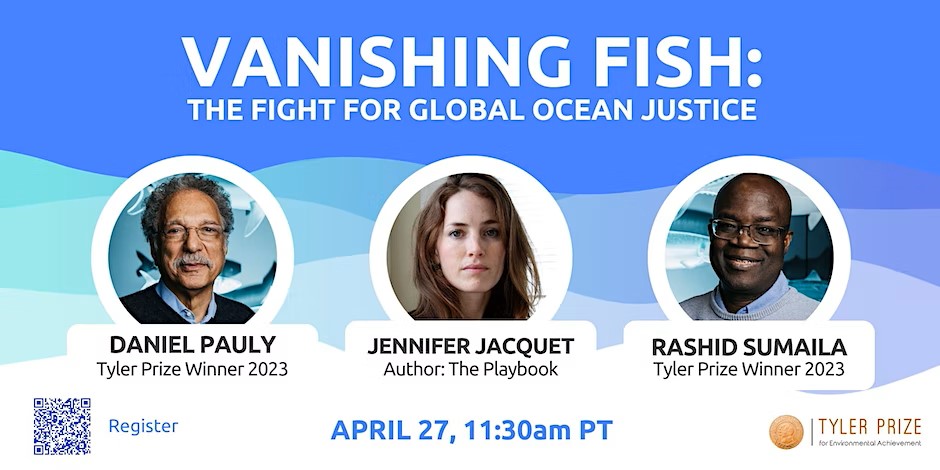
Event - Vanishing Fish The Fight for Global Ocean Justice

Three leading environmental thinkers discuss the global fight for ocean justice, in a world grappling with the impacts of overfishing and climate change. They will also discuss the ‘ call to end fishing on the high seas – as well as reflect on the Tyler Prize, which is this year celebrating its 50th Anniversary.

Eight urgent, fundamental and simultaneous steps needed to restore ocean health, and the consequences for humanity and the planet of inaction or delay

Abstract

  1. The ocean crisis is urgent and central to human wellbeing and life on Earth; past and current activities are damaging the planet's main life support system for future generations. We are witnessing an increase in ocean heat, disturbance, acidification, bio‐invasions and nutrients, and reducing oxygen levels. Several of these act like ratchets: once detrimental or negative changes have occurred, they may lock in place and may not be reversible, especially at gross ecological and ocean process scales.
  2. Each change may represent a loss to humanity of resources, ecosystem function, oxygen production and species. The longer we pursue unsuitable actions, the more we close the path to recovery and better ocean health and greater benefits for humanity in the future.
  3. We stand at a critical juncture and have identified eight priority issues that need to be addressed in unison to help avert a potential ecological disaster in the global ocean. They form a purposely ambitious agenda for global governance and are aimed at informing decision‐makers at a high level. They should also be of interest to the general public.
  4. Of all the themes, the highest priority is to rigorously address global warming and limit surface temperature rise to 1.5°C by 2100, as warming is the pre‐eminent factor driving change in the ocean. The other themes are establishing a robust and comprehensive High Seas Treaty, enforcing existing standards for Marine Protected Areas and expanding their coverage, especially in terms of high levels of protection, adopting a precautionary pause on deep‐sea mining, ending overfishing and destructive fishing practices, radically reducing marine pollution, putting in place a financing mechanism for ocean management and protection, and lastly, scaling up science/data gathering and facilitating data sharing.
  5. By implementing all eight measures in unison, as a coordinated strategy, we can build resilience to climate change, help sustain fisheries productivity, particularly for low‐income countries dependent on fisheries, protect coasts (e.g. via soft‐engineering/habitat‐based approaches), promote mitigation (e.g. carbon storage) and enable improved adaptation to rapid global change.

Climate change impact on Canada's Pacific marine ecosystem: the current state of knowledge.

Global warming is already affecting the oceans through changes in water temperature, acidification, oxygen content and sea level rise, amongst many others. These changes are having multiple effects on marine species worldwide, with subsequent impacts on marine fisheries, peoples' livelihoods and food security. This work presents a review of the recent literature on the current and projected impacts of climate change on Canada's Pacific marine ecosystem. We find that there is an increasing number of studies in British Columbia focusing on changes in ocean conditions and marine species responses under climate change, including an emerging literature on the socio-economic impacts of these changes considered to be a knowledge gap. According to the literature, it is well established that ocean temperatures are increasing over the long-term, especially, in southern areas of British Columbia. Warming trends are increasing in the spring and are strongest in summer. However, there are important uncertainties regarding other climate drivers, such as oxygen concentration and acidification, stemming mainly from the insufficiency of data. Pacific salmon, elasmobranchs, invertebrates and rockfishes are amongst the most vulnerable species groups to climate change in British Columbia. Also, shifts in stock distribution and fish abundance under climate change may have a significant impact on fish supply affecting the livelihoods and food security of some British Columbians. The magnitude of these impacts is likely to vary according to a latitudinal gradient, with southern coastal areas being more affected than northern and central areas; challenging multiple areas of governance, such as equity and fishing access amongst First Nations; and institutional arrangements for transboundary stocks between the U.S. and Canada.


Illicit trade in the marine resources of West Africa

The goals of this paper are threefold. First, it quantitatively and qualitatively determines the economic and social cost of illicit trade in marine resources of West Africa. Second, the paper discusses the channels and scale of illicit trade in fish and fish products. Third, the economic loss and impacts from illicit trade are determined and policy options for curbing this trade suggested. We found substantial effects of illicit trade in the marine resources of West Africa, in terms of economic impact (defined as the added value through the fish value chain generated from the revenues earned from fishing), income, jobs and tax revenue impacts. For instance, the region as a whole is estimated to be losing economic and income impacts of nearly US$1,950 million and US$593 million, per year, respectively.

In political seas: engaging with political ecology in the ocean and coastal environment

The world’s oceans and coasts are awash in a sea of politics. The marine environment is increasingly busy, changing, and a site of degradation, marginalization, injustice, contestation and conflict over declining resources and occupied spaces at local to global scales. Themes of political ecology, such as power and politics, narratives and knowledge, scale and history, environmental justice and equity, are thus salient issues to understand in ocean and coastal governance and management. This subject review examines research on these themes of political ecology in the ocean and coastal environment and reflects on how the insights gained might be applied to governance and management. Political ecology provides important insights into: the influence of power in ocean management and governance processes; the manner in which narratives, knowledge, and scale are used to legitimize and shape policies and management efforts; the effects of historical trajectories on present circumstances, options, and practices; and the nature of inequities and environmental injustices that can occur in the marine environment. Moreover, ocean and coastal researchers, practitioners, and decision makers ought to engage with the political processes and injustices occurring in the ocean. Moving from critical insights to constructive engagements will ensure that political ecology helps to plant seeds of hope in the Anthropocene ocean. (Full publication)

Establishing company level fishing revenue and profit losses from fisheries: A bottom-up approach

A third of global fish stocks are overexploited and many are economically underperforming, resulting in potential unrealized net economic benefits of USD 51 to 83 billion annually. However, this aggregate view, while useful for global policy discussion, may obscure the view for those actors who engage at a regional level. Therefore, we develop a method to associate large companies with their fishing operations and evaluate the biological sustainability of these operations. We link current fish biomass levels and landings to the revenue streams of the companies under study to compute potentially unrealized fisheries revenues and profits at the level of individual firms. We illustrate our method using two case studies: anchoveta (Engraulis ringens; Engraulidae) in Peru and menhaden in the USA (Brevoortia patronus and B. _tyrannus;_Clupeidae). We demonstrate that both these fisheries could potentially increase their revenues compared to the current levels of exploitation. We estimate the net but unrealized fishery benefits for the companies under question. This information could be useful to investors and business owners who might want to be aware of the actual fisheries performance options of the companies they invest in. (Full publication)

Potential impacts of finfish aquaculture on eelgrass (Zostera marina) beds and possible monitoring metrics for management: a case study in Atlantic Canada

Eelgrass (Zostera marina) has been designated an Ecologically Significant Species in Atlantic Canada. The development and rapid expansion of netpen finfish aquaculture into sensitive coastal habitats has raised concerns about the impacts of finfish aquaculture on eelgrass habitats. To date, no studies have been done in Atlantic Canada to examine these impacts or to identify potential monitoring variables that would aid in the development of specific conservation and management objectives. As a first step in addressing this gap, we examined differences in environmental variables, eelgrass bed structure and macroinfauna communities at increasing distances from a finfish farm in Port Mouton Bay, a reference site in adjacent Port Joli Bay, and published survey results from other sites without finfish farms along the Atlantic Coast of Nova Scotia. Drawing on research done elsewhere and our results, we then identified possible metrics for assessing and monitoring local impacts of finfish aquaculture on eelgrass habitats. Our results suggest some nutrient and organic enrichment, higher epiphyte loads, lower eelgrass cover and biomass, and lower macroinfauna biomass closer to the farm. Moreover, community structure significantly differed between sites with some species increasing and others decreasing closer to the farm. Changes in the macroinfauna community could be linked to observed differences in environmental and eelgrass bed variables. These results provide new insights into the potential impacts of finfish aquaculture on eelgrass habitats in Atlantic Canada. We recommend a suite of measures for assessment and monitoring that take into account response time to disturbance and account for different levels of eelgrass organizational response (from physiological to community). Download PDF  | View Publication | View at Peer Journal