9 posts tagged with "Overfishing"

View All Tags

Originally posted on the Sea Around Us website.

Event - Vanishing Fish The Fight for Global Ocean Justice

Three leading environmental thinkers discuss the global fight for ocean justice, in a world grappling with the impacts of overfishing and climate change. They will also discuss the ‘ call to end fishing on the high seas – as well as reflect on the Tyler Prize, which is this year celebrating its 50th Anniversary.

Updated estimates and analysis of global fisheries subsidies

The period from 2019 to 2020 is critical in determining whether the World Trade Organization (WTO), tasked with eliminating capacity-enhancing fisheries subsidies, can deliver to the world an agreement that will discipline subsidies that lead to overfishing. Here, following extensive data collection efforts, we present an update of the current scope, amount and analysis of the level of subsidisation of the fisheries sector worldwide. We estimate global fisheries subsidies at USD 35.4 billion in 2018, of which capacity-enhancing subsidies are USD 22.2 billion. The top five subsidising political entities (China, European Union, USA, Republic of Korea and Japan) contribute 58% (USD 20.5 billion) of the total estimated subsidy. The updated global figure has decreased since the most recent previous estimate from 2009, of USD 41.4 billion in 2018 constant dollars. The difference between these two estimates can be largely explained by improvements in methodology and the difference in the actual amount of subsidies provided. Thus, we consider direct statistical comparison of these numbers to be inappropriate. Having said that, the difference between the estimates suggest that the increase in fisheries subsidies provided in the preceding decades may have halted. Still, the bulk of harmful ‘capacity-enhancing’ subsidies, particularly those for fossil fuels have actually increased as a proportion of total subsidies. As such, for the benefit of marine ecosystems, and current and future generations of people, all hands must be on deck in helping the WTO reach a meaningful agreement to discipline subsidies that lead to overcapacity and overfishing.


Originally posted at Oceana Canada.


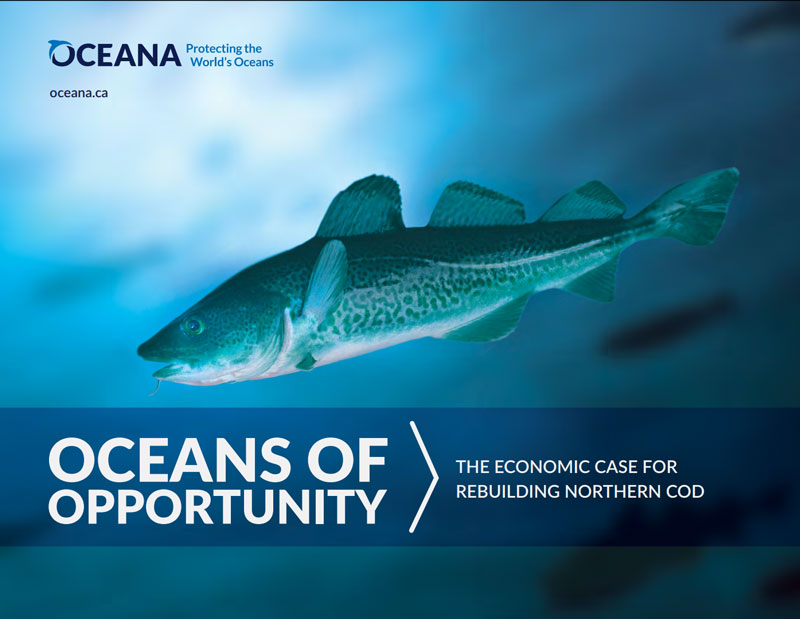
Oceans of Opportunity: The economic case for rebuilding northern cod highlights that a rebuilt northern cod fishery could provide 16 times more jobs and have a net present value worth up to five times more than today. With low fishing pressure and favourable environmental conditions, the fishery could recover in as few as 11 years, supporting economic activities worth $233 million in today’s dollars.

Fishery subsidies: the interaction between science and policy.

Fisheries subsidies have attracted considerable attention worldwide since the 1990s. The World Trade Organization (WTO), among others, started to strengthen its disciplines in fisheries subsidies in 2001. The academic study of fisheries subsidies can play a key role in contributing to policy-making processes such as WTO negotiations by providing more accurate information on the link between subsidies and overfishing. This paper aims to review the existing academic literature and discuss the role of academic studies in the process of designing and implementing policies on fisheries subsidies. Academic studies on fishery subsides can be divided into three branches: descriptive, theoretical, and empirical. Overall, there has been significant progress in empirical studies on fishery subsidies during the last decade. While the number of studies is still limited, they generate insights that are consistent with theoretical predictions. As for potential contributions of academic studies to actual policies and sustainable management, more interaction between academic experts and policy makers is desirable.

Subsidies reduce marine fisheries wealth.

(book chapter (chapter 10) in The Changing Wealth of Nations 2018: Building a Sustainable Future)

  • After steadily increasing over decades, annual global production of capture fisheries has plateaued just above 80 million metric tons. From a peak of 86 million tons in 1996, global marine catches have shown a small downward trend of about 0.2 million ton per year.
  • Globally, the proportion of fully fished stocks and overfished, depleted, or recovering fish stocks has increased from slightly more than 50 percent of all assessed fish stocks in the mid-1970s to about 75 percent in 2005, and to almost 90 percent in 2013.
  • As global marine catches have stagnated and even declined, fishing effort has greatly expanded over the past 70 years. Over the same period the level of global marine catches has not even doubled, suggesting a steep decline in the catch per unit effort, often considered a measure of fishing productivity.
  • At the global level, the data show that, overall, global fisheries have foregone US$83 billion of rent in 2012. Fisheries are heavily subsidized and in many countries resource rents from fisheries are negative—meaning that revenues do not fully cover the costs of fishing.

Does trade openness reduce a domestic fisheries catch?

Although trade liberalization may increase a country’s welfare, its specific effect on a country’s fishing industry has not been well studied. By decomposing the effect of international trade into four parts, i.e., scale-technique effects (ST), the indirect trade-induced composition effect (IC), the indirect effect of trade intensity through income (ITC), and the direct effect of trade intensity (DTC), this study empirically investigates the effect of trade openness on country-level fisheries production. To take into account the endogeneity of trade openness and income, we adopt the instrumental variable approach. We find that a rise in trade openness reduces fisheries catch on average. In particular, the long-run effect is large. This result implies that future production is affected by current overfishing through stock dynamics. Our decomposed elasticities indicate that the ST and ITC dominate in the trade elasticity of fisheries catch. While ST implies that overfishing would be affected by trade, ITC may either establish an “overfishing haven”, similar to a “pollution haven” in the environmental literature, or production shift of fisheries to countries with lax regulation to pass stringent regulation, which is more likely to occur in high-income countries.

Economic incentives and overfishing: a bioeconomic vulnerability index.

Bioeconomic theory predicts that the trade-offs between maximization of economic benefits and conservation of vulnerable marine species can be assessed using the ratio between the discount rate of fishers and the intrinsic rate of growth of the exploited populations. In this paper, we use this theory to identify areas of the global ocean where higher vulnerability of fishes to overfishing would be expected in the absence of management. We derive an index to evaluate the level of vulnerability by comparing discount rates and fishes’ intrinsic population growth rates. Using published discount rates of countries that are reported to fish in the ocean and estimating the intrinsic population growth rate for major exploited fishes in the world, we calculate the vulnerability index for each 0.5° latitude × 0.5° longitude grid for each taxon and each fishing country. Our study shows that vulnerability is inherently high on the northeastern coast of Canada, the Pacific coast of Mexico, the Peruvian coast, in the South Pacific, on the southern and southeastern coast of Africa, and in the Antarctic region. It should be noted that this index does not account for the management regime currently in place in different areas, and thus mainly reflects the vulnerability resulting from the intrinsic life history characteristics of the fish species being targeted and the discount rates of the fishers exploiting them. Despite the uncertainties of this global-scale analysis, our study highlights the potential applications of large-scale spatial bioeconomics in identifying areas where fish stocks are more likely to be over-exploited when there is no effective fisheries management; this applies to many fisheries around the world today.

New Research: Could Canada benefit from closing the high seas to fishing?

In a thought-provoking paper released in Scientific Reports last week, OceanCanada Director Dr. Rashid Sumaila and his team of researchers uncovered the possible winners and losers in a world where the high seas is closed to fishing. Researchers found that closing the high seas to commercial fishing could be catch-neutral, and might even contribute to a more equitable distribution of the world's fisheries resources. Among the "winners" in this scenario, Canada would see an increase of $125 million (USD) per year.

Interview: Vancouver Real episode #025 - "Running out of FISH" with Dr. Rashid Sumaila

This episode features Director and Professor at the Fisheries Economics Research Unit at UBC, Dr. Rashid Sumaila. He explained to us the threat of over-fishing and how taxpayer money is currently being used to actually support the over-fishing that is occurring in Canada. Siting recent research he gives a great understanding of where the fishing industry is at and how long we have before things get even worse. Reality check!