
11 posts tagged with "Marine Protected Areas"

View All Tags

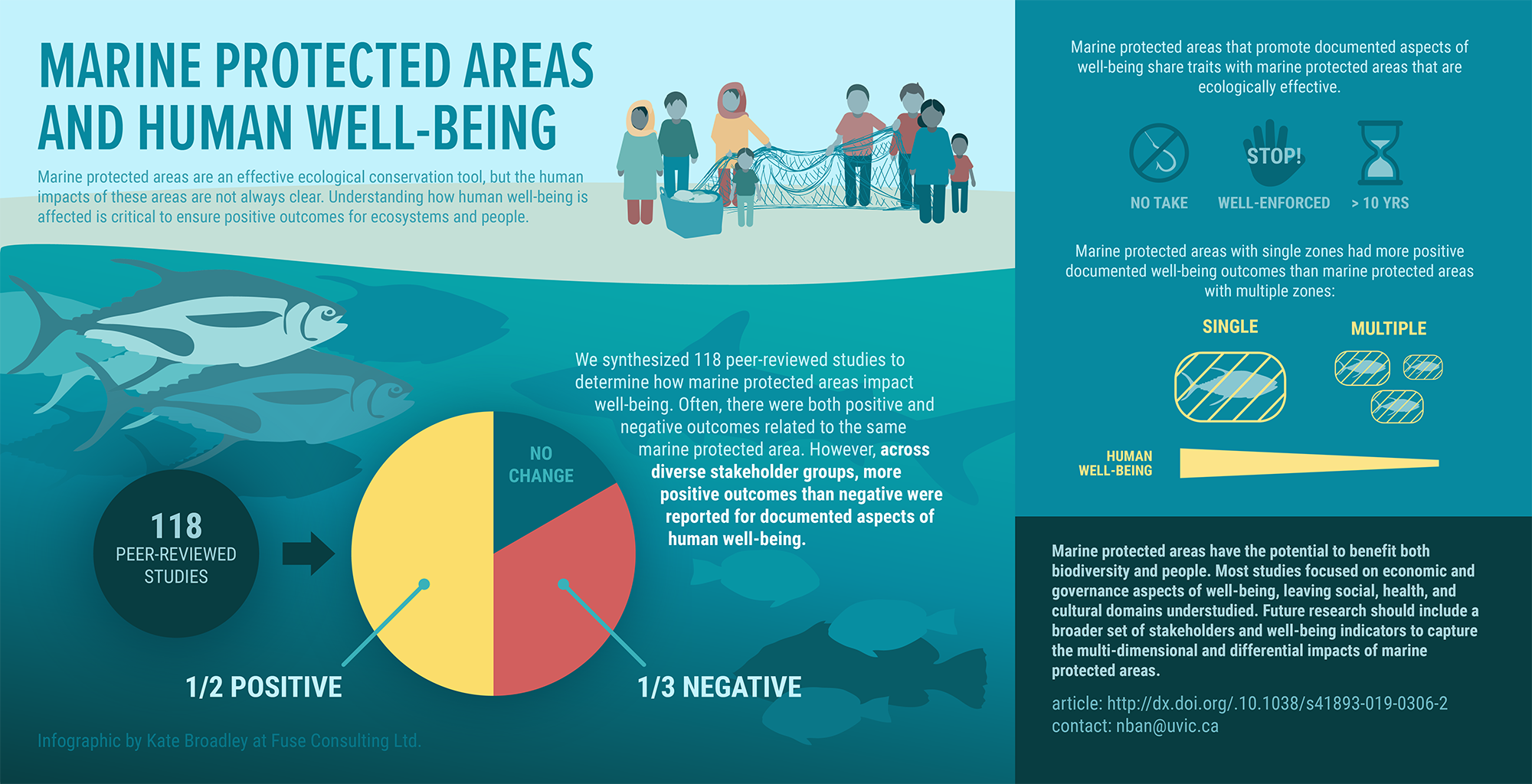
Well-being outcomes of marine protected areas.

Marine protected areas are advocated as a key strategy for simultaneously protecting marine biodiversity and supporting coastal livelihoods, but their implementation can be challenging for numerous reasons, including perceived negative effects on human well-being. We synthesized research from 118 peer-reviewed articles that analyse outcomes related to marine protected areas on people, and found that half of documented well-being outcomes were positive and about one-third were negative. No-take, well-enforced and old marine protected areas had positive human well-being outcomes, which aligns with most findings from ecological studies. Marine protected areas with single zones had more positive effects on human well-being than areas with multiple zones. Most studies focused on economic and governance aspects of well-being, leaving social, health and cultural domains understudied. Well-being outcomes arose from direct effects of marine protected area governance processes or management actions and from indirect effects mediated by changes in the ecosystem. Our findings illustrate that both human well-being and biodiversity conservation can be improved through marine protected areas, yet negative impacts commonly co-occur with benefits.

Local support for conservation is associated with perceptions of good governance, social impacts, and ecological effectiveness

Local support is important for the longevity of conservation initiatives. The literature suggests that perceptions of ecological effectiveness, social impacts, and good governance will influence levels of local support for conservation. This paper examines these relationships using data from a survey of small‐scale fishermen in 11 marine protected areas from six countries in the Mediterranean Sea. The survey queried small‐scale fishermen regarding perceptions and support for conservation. We constructed composite scores for three categories of perceptions—ecological effectiveness, social impacts, and good governance—and tested the relationship with levels of support using ordinal regression models. While all three factors were positively correlated with support for conservation, perceptions of good governance and social impacts were stronger predictors of increasing support. These findings suggest that employing good governance processes and managing social impacts may be more important than ecological effectiveness for maintaining local support for conservation. (Full publication)

A modelling approach to assess the impact of land mining on marine biodiversity: assessment in coastal catchments experiencing catastrophic events (SW Brazil).

Analysis that link hydrological processes with oceanographic dispersion offer a promising approach for assessing impacts of land-based activities on marine ecosystems. However, such an analysis has not yet been customised to quantify specific pressures from mining activities on marine biodiversity including those from spillages resulting from tailing dam failure. Here, using a Brazilian catchment in which a tailing dam collapsed (Doce river) as a case study, we provide a modelling approach to assess the impacts on key ecosystems and marine protected areas subjected to two exposure regimes: (i) a pulse disturbance event for the period 2015–2016, following the immediate release of sediments after dam burst, which witnessed an average increase of 88% in sediment exports; and (ii) a press disturbance phase for the period 2017–2029, when impacts are sustained over time by sediments along the river's course. We integrated four components into impact assessments: hydrological modelling, coastal-circulation modelling, ecosystem mapping, and biological sensitivities. The results showed that pulse disturbance causes sharp increases in the amount of sediments entering the coastal area, exposing key sensitive ecosystems to pollution (e.g. rhodolith beds), highlighting an urgent need for developing restoration strategies for these areas. The intensity of impacts will diminish over time but the total area of sensitive ecosystems at risk are predicted to be enlarged. We determined monitoring and restoration priorities by evaluating and comparing the extent to which sensitive ecosystems within marine protected areas were exposed to disturbances. The information obtained in this study will allow the optimization of recovery efforts in the marine area affected, and valuation of ecosystem services lost. (Full publication)

Addressing criticisms of large-scale Marine Protected Areas.

Designated large-scale marine protected areas (LSMPAs, 100,000 or more square kilometers) constitute over two-thirds of the approximately 6.6% of the ocean and approximately 14.5% of the exclusive economic zones within marine protected areas. Although LSMPAs have received support among scientists and conservation bodies for wilderness protection, regional ecological connectivity, and improving resilience to climate change, there are also concerns. We identified 10 common criticisms of LSMPAs along three themes: (1) placement, governance, and management; (2) political expediency; and (3) social–ecological value and cost. Through critical evaluation of scientific evidence, we discuss the value, achievements, challenges, and potential of LSMPAs in these arenas. We conclude that although some criticisms are valid and need addressing, none pertain exclusively to LSMPAs, and many involve challenges ubiquitous in management. We argue that LSMPAs are an important component of a diversified management portfolio that tempers potential losses, hedges against uncertainty, and enhances the probability of achieving sustainably managed oceans.

Human dimensions of large-scale marine protected areas: advancing research and practice.

This special issue of Coastal Management focuses on the human dimensions of large-scale marine protected areas (LSMPAs), those MPAs that are typically larger than 250,000 km2. We define ‘human dimensions’ as the cultural, social, economic, political, and institutional factors that affect and are affected by large-scale marine conservation efforts. While human dimensions of marine conservation and coastal management have long been a focus of research, they have not yet received sustained and systematic consideration in relation to LSMPAs specifically. Although there is an emerging body of scholarship focused on the human dimensions of LSMPAs, this is the first collection of papers devoted to their analysis. The purpose of this special issue is to showcase the diversity of human dimensions of LSMPAs, illustrating the range of contexts in which LSMPAs function, the variety of social science tools that can be used to analyze LSMPAs, the ways that human dimensions considerations can be integrated into LSMPA management, and the diverse human dimensions outcomes that are associated with LSMPAs.

Why people matter in ocean governance: incorporating human dimensions into large-scale marine protected areas.

Large-scale marine protected areas (LSMPAs) are rapidly increasing. Due to their sheer size, complex socio-political realities, and distinct local cultural perspectives and economic needs, implementing and managing LSMPAs successfully creates a number of human dimensions challenges. It is timely and important to explore the human dimensions of LSMPAs. This paper draws on the results of a global “Think Tank on the Human Dimensions of Large Scale Marine Protected Areas” involving 125 people from 17 countries, including representatives from government agencies, non-governmental organizations, academia, professionals, industry, cultural/indigenous leaders and LSMPA site managers. The overarching goal of this effort was to be proactive in understanding the issues and developing best management practices and a research agenda that address the human dimensions of LSMPAs. Identified best management practices for the human dimensions of LSMPAs included: integration of culture and traditions, effective public and stakeholder engagement, maintenance of livelihoods and wellbeing, promotion of economic sustainability, conflict management and resolution, transparency and matching institutions, legitimate and appropriate governance, and social justice and empowerment. A shared human dimensions research agenda was developed that included priority topics under the themes of scoping human dimensions, governance, politics, social and economic outcomes, and culture and tradition. The authors discuss future directions in researching and incorporating human dimensions into LSMPAs design and management, reflect on this global effort to co-produce knowledge and re-orient practice on the human dimensions of LSMPAs, and invite others to join a nascent community of practice on the human dimensions of large-scale marine conservation.
Building towards the marine conservation end-game: consolidating the role of MPAs in a future ocean.

  • Progress on spatial conservation efforts in marine environments is often summarized with the simplistic metric of extent. However, targets require a more nuanced view, where ecological effectiveness, biodiversity, representation, connectivity and ecosystem services must all be recognized. Furthermore, these targets must be achieved through equitable processes and produce equitable outcomes.
  • This paper calls for a clearer definition of what is to be ‘counted’ in assessing progress in marine conservation, through the use of both traditionally defined marine protected areas and a limited subset of other equivalent areas. It calls for future effort to draw a clear distinction between non-extractive areas such as no-take marine reserves, and the more numerous extractive areas. To be considered protected, sites must be ecologically effective, and be equitably managed to support all stakeholders.
  • Spatial extent of coverage is only one constituent part of conservation effort, however, and much greater effort is needed to ensure that sites are selected to achieve optimum conservation outcomes for biodiversity and for ecosystem services. The paper reviews some of the existing views and approaches to defining and delimiting marine protection priorities.
  • It recommends that with a clearer set of metrics for defining protection, and for assessing progress and setting future targets, marine conservation will be better placed to achieve lasting outcomes, including halting biodiversity loss and securing or enhancing ecosystem service provision. Protected spaces will continue to play a major role in future oceans, but they also need to be configured within a wider spatial framework.

Imprecise and weakly assessed: evaluating voluntary measures for management of marine protected areas

Voluntary measures may be an alternative or addition to legislation for marine protected areas (MPAs), yet the effectiveness of these measures is rarely analyzed. The application and effectiveness of voluntary measures was reviewed for MPA management in developed nations where complex jurisdictions and legislative processes make voluntary measures appealing to management. Four types of voluntary measures were identified: sacrifice of access, sector- or activity-specific restrictions, voluntary stewardship, and education or outreach, with sector- or activity-specific measures being the most common. Very few papers (only 20 of 144) provided thorough assessments of outcomes or effectiveness of voluntary measures; of these, less than a quarter pointed to successful outcomes in connection with voluntary measures for MPAs or marine conservation more broadly, while half indicated mixed or uncertain results. The main factor to which failure of voluntary measures was attributed was the lack of leverage to discourage non-compliance. Key factors for the success of voluntary measures included community support, cohesive user organizations, and good governance (i.e., leadership, financing, a perception of fairness). To improve efficacy of voluntary measures for MPAs, empirical research is needed to establish effective circumstances where, when, and how voluntary measures can be applied to address management objectives.