News

Dr. Rashid Sumaila is one of seven UBC faculty members who have been named as Fellows of the Royal Society of Canada (RSC). The fellowship of the RSC comprises over 2000 Canadian scholars, artists, and scientists, peer-elected as the best in their field. These are distinguished men and women from all branches of learning who have made remarkable contributions in the arts, the humanities and the sciences, as well as in Canadian public life.

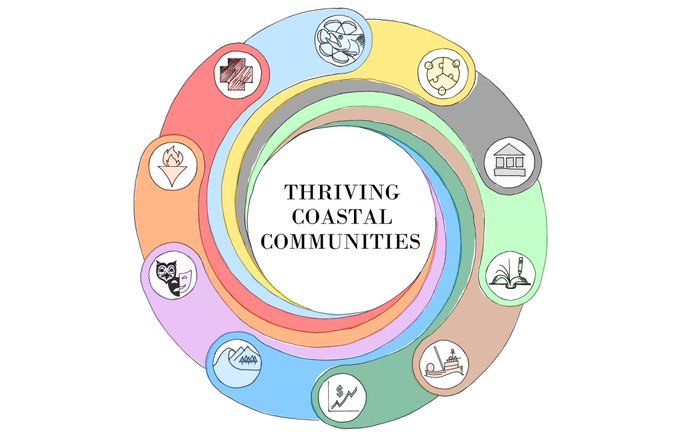
A new report titled “The Thriving Coastal Communities Initiative: Towards an action research agenda focused on well-being in coastal communities in British Columbia” has been produced in a group effort between T.Buck Suzuki Environmental Foundation and OceanCanada's Dr. Nathan Bennett, as well as a large team of collaborators. Support for convening the initial meeting at the University of British Columbia came from the Vancouver Foundation.

The Thriving Coastal Communities Initiative

Rural and resource-based coastal communities in British Columbia (BC) are facing a number of pressing challenges that are affecting the holistic health and well-being of local people. The challenges facing coastal communities include being disconnected from decision-making process, a changing climate, rapidly evolving ecosystems, increasing pollution, declining investment, loss of community infrastructure, increasing competition over marine space, loss of access to fisheries and increasingly complex marine management regimes. Local communities are feeling the impacts of these pressures and changes in very real ways. Research into communities on the BC coast suggests that they are experiencing loss of livelihoods, declining economies, outmigration of youth to urban centers, loss of food security, increasing drug use, and a suite of physical and mental health challenges. It is important that coastal communities continue to thrive and maintain an active presence on the water. Yet, change is a constant for coastal communities. The health and well-being, indeed the persistence, of coastal communities depends on their capacity to proactively respond to external change and challenge. The presence of thriving communities on the coast is also important for Canadian society - as coastal communities can strengthen rural-urban dynamics, support robust food systems and economies, be the eyes on the longest coastline in the world, be first responders in the case of emergencies, and be active stewards of the marine environment.

OceanCanada Newsletter - Summer 2019

OCEANCANADA NEWS

Rashid Sumaila Named Canada Research Chair Rashid has been named Canada Research Chair (Tier 1) in Interdisciplinary Ocean and Fisheries Economics. The Canada Research Chair Program, supported by the Canada Foundation for Innovation, provides funding to support academic research and training excellence. Congratulations, Rashid! Read more here.

The potential for locally managed marine area (LMMAs) as a participatory strategy for coastal and marine ecosystems - the global commons

Marine and coastal biodiversity and ecosystem services are degraded in many areas worldwide due to human interference resulting from fishing, tourism, pollution, and mining. Guidelines for an evidence-based, participatory and community-led management approach ‘Locally Managed Marine Area (LMMA)’ provides a planning and strategic approach to development of coastal cities and implementing Integrated Coastal Zone Management. Here we take note of the existing references of case studies that shows successful implementation in Fiji, Kenya and other countries in Asia and Africa. LMMA approach integrates concerns about the current state of degradation and ensures that ecological services of these resource systems are sustainably managed in the future by community driven efforts; with aspects of food security, resource conservation, local employment and income of local fishers and tourism operators embedded. We focus on an empirical assessment initiated though a collaborative effort to outline and set up guidelines for establishing a LMMA network for Inhambane, Mozambique in discussion with stakeholders (fishermen, tourism operators, private and community actors, and selected government officials). An outcome from the study was disseminated to local authorities to ensure that solutions for managing degradation coastal and marine ecosystems could be placed on priority as planning for implementation of Sustainable Development Goal 14 and for creating coastal cities as sustainable economic hubs and resilient coastal communities.

Eight urgent, fundamental and simultaneous steps needed to restore ocean health, and the consequences for humanity and the planet of inaction or delay

Abstract

  1. The ocean crisis is urgent and central to human wellbeing and life on Earth; past and current activities are damaging the planet's main life support system for future generations. We are witnessing an increase in ocean heat, disturbance, acidification, bio‐invasions and nutrients, and reducing oxygen levels. Several of these act like ratchets: once detrimental or negative changes have occurred, they may lock in place and may not be reversible, especially at gross ecological and ocean process scales.
  2. Each change may represent a loss to humanity of resources, ecosystem function, oxygen production and species. The longer we pursue unsuitable actions, the more we close the path to recovery and better ocean health and greater benefits for humanity in the future.
  3. We stand at a critical juncture and have identified eight priority issues that need to be addressed in unison to help avert a potential ecological disaster in the global ocean. They form a purposely ambitious agenda for global governance and are aimed at informing decision‐makers at a high level. They should also be of interest to the general public.
  4. Of all the themes, the highest priority is to rigorously address global warming and limit surface temperature rise to 1.5°C by 2100, as warming is the pre‐eminent factor driving change in the ocean. The other themes are establishing a robust and comprehensive High Seas Treaty, enforcing existing standards for Marine Protected Areas and expanding their coverage, especially in terms of high levels of protection, adopting a precautionary pause on deep‐sea mining, ending overfishing and destructive fishing practices, radically reducing marine pollution, putting in place a financing mechanism for ocean management and protection, and lastly, scaling up science/data gathering and facilitating data sharing.
  5. By implementing all eight measures in unison, as a coordinated strategy, we can build resilience to climate change, help sustain fisheries productivity, particularly for low‐income countries dependent on fisheries, protect coasts (e.g. via soft‐engineering/habitat‐based approaches), promote mitigation (e.g. carbon storage) and enable improved adaptation to rapid global change.

Originally posted at UBC Oceans.


IOF and IRES student Sarah Harper has won the inaugural Sumaila-Volvo Graduate Prize in Environmental Sustainability.

This prize was been made available through an endowment established by Dr. Rashid Sumaila, upon being named the 2017 Volvo Environment Prize laureate. The prize is for a Master’s or Ph.D. student whose peer-reviewed publications to date are expected to have the most significant impact on the field of environmental sustainability. Preference is given to students supervised by faculty members who are affiliated with the Institute for the Oceans and Fisheries; the Institute for Resources, Environment and Sustainability; or the School of Public Policy and Global Affairs.

No fear of bankruptcy: the innate self-subsidizing forces in recreational fishing

Recreational fishing, by both local residents and tourists, is a popular activity globally. The behaviour and motivation of recreational fishers is different from those of commercial fishers. Unlike the latter, the former are not dependent on making profits to continue fishing. Rather, the value of recreational fishing to those who engage in it is a combination of catches and experience values. The latter value implies that recreational fishers might continue fishing when they should not, analogous to the effect of subsidy in the commercial fishing sector. Hence, the term “self-subsidizing”: a fishery as one in which fishers subsidize themselves through an economic investment in gear and time from their non-fishery-based earnings. The consequence of which is that recreational fishers can continue fishing long after the commercial fishing industry has stopped fishing because their operations have become economically unviable. There is reason to argue that in many areas, recreational fishing effort, due to the self-subsidizing mechanism, is sustained at a high rate while stocks decrease. In this contribution, we describe the innate self-subsidizing forces in recreational fishing and discuss their implications.

Ecological connectivity between the areas beyond national jurisdiction and coastal waters: safeguarding interests of coastal communities in developing countries.

The UN General Assembly has made a unanimous decision to start negotiations to establish an international, legally-binding instrument for the conservation and sustainable use of marine biological diversity within Areas Beyond National Jurisdiction (ABNJ). However, there has of yet been little discussion on the importance of this move to the ecosystem services provided by coastal zones in their downstream zone of influence. Here, we identify the ecological connectivity between ABNJ and coastal zones as critically important in the negotiation process and apply several approaches to identify some priority areas for protection from the perspective of coastal populations of Least Developed Countries (LDCs). Initially, we review the scientific evidence that demonstrates ecological connectivity between ABNJ and the coastal zones with a focus on the LDCs. We then use ocean modelling to develop a number of metrics and spatial maps that serve to quantify the connectivity of the ABNJ to the coastal zone. We find that the level of exposure to the ABNJ influences varies strongly between countries. Similarly, not all areas of the ABNJ are equal in their impacts on the coastline. Using this method, we identify the areas of the ABNJ that are in the most urgent need of protection on the grounds of the strength of their potential downstream impacts on the coastal populations of LDCs. We argue that indirect negative impacts of the ABNJ fishing, industrialisation and pollution, communicated via oceanographic, cultural and ecological connectivity to the coastal waters of the developing countries should be of concern.