News

Well-being outcomes of marine protected areas.

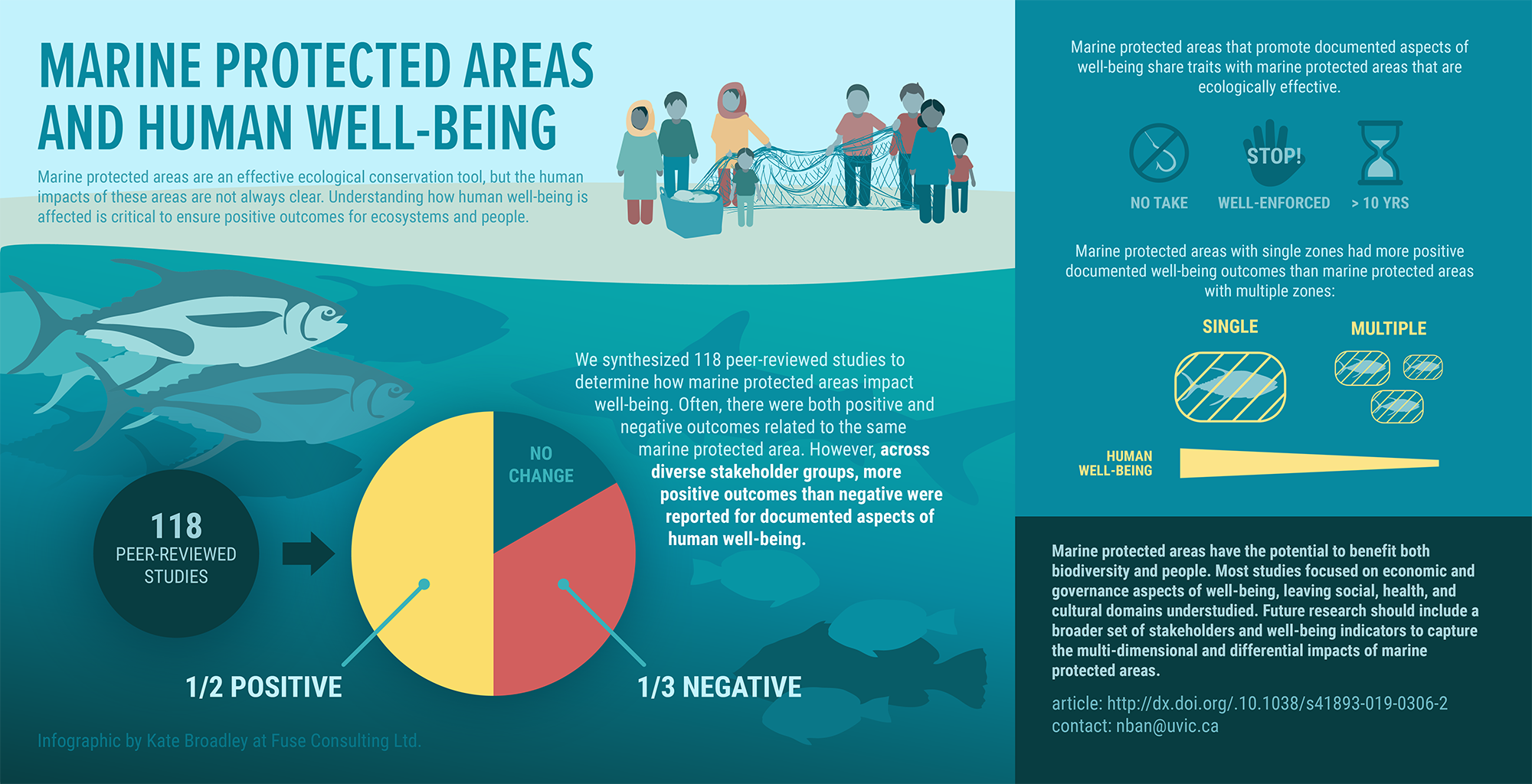
Marine protected areas are advocated as a key strategy for simultaneously protecting marine biodiversity and supporting coastal livelihoods, but their implementation can be challenging for numerous reasons, including perceived negative effects on human well-being. We synthesized research from 118 peer-reviewed articles that analyse outcomes related to marine protected areas on people, and found that half of documented well-being outcomes were positive and about one-third were negative. No-take, well-enforced and old marine protected areas had positive human well-being outcomes, which aligns with most findings from ecological studies. Marine protected areas with single zones had more positive effects on human well-being than areas with multiple zones. Most studies focused on economic and governance aspects of well-being, leaving social, health and cultural domains understudied. Well-being outcomes arose from direct effects of marine protected area governance processes or management actions and from indirect effects mediated by changes in the ecosystem. Our findings illustrate that both human well-being and biodiversity conservation can be improved through marine protected areas, yet negative impacts commonly co-occur with benefits.

Story originally posted at UBC Oceans.


The Institute for the Oceans and Fisheries is pleased that today’s Government of Canada announcement of new Canada Research Chairs revealed that Dr. U. Rashid Sumaila has been named as Canada Research Chair in Interdisciplinary Ocean and Fisheries Economics (Tier 1), and Dr. Marie Auger-Méthé has been named Canada Research Chair in Statistical Ecology (Tier 2).

Sustainable aquaculture in Canada: Lost in translation

Canada is a signatory to United Nations conventions on sustainable development and has entrenched sustainability goals in legislation and policies relating to natural resource sectors including aquaculture. Monitoring and measuring progress towards sustainable development requires the development of sustainability indicators (SI) that, when measured, indicate movement towards or away from a stated policy objective, as well as providing the public with a measure of government accountability. This paper examined the SI used by the Canadian government to assess the social, economic and environmental sustainability of aquaculture production in Canada, whether they adequately measure policy outcomes, and whether national-level SI indicators are appropriate to assessing sustainability at the community-level. The analysis reveals that the Canadian government has made virtually no progress towards translating sustainable aquaculture policy aspirations into measurable SI that evaluate policy outcomes. The mismatch between national policy goals and on-the-ground consequences are highlighted in a community case study of finfish aquaculture in Port Mouton Bay (Nova Scotia). Aquaculture SI and sustainability narratives are discussed in relation to emergent governance arrangements (certification programs) and an international development initiative, Blue Growth, for the world's oceans.

OceanCanada Newsletter - Spring 2019

OCEANCANADA NEWS

Beyond Climate Ian Mauro has been touring and continues to tour the film he directed Beyond Climate with narrator David Suzuki. Several showings followed by Q & A sessions have been held in various locations. He and David Suzuki will be in attendance at a showing at the Congress of the Humanities and Social Sciences at UBC in Vancouver on June 4, 2019. It has also been accepted at fourteen film festivals. Click here for more information and to view the trailer.

Originally posted at Oceana Canada.


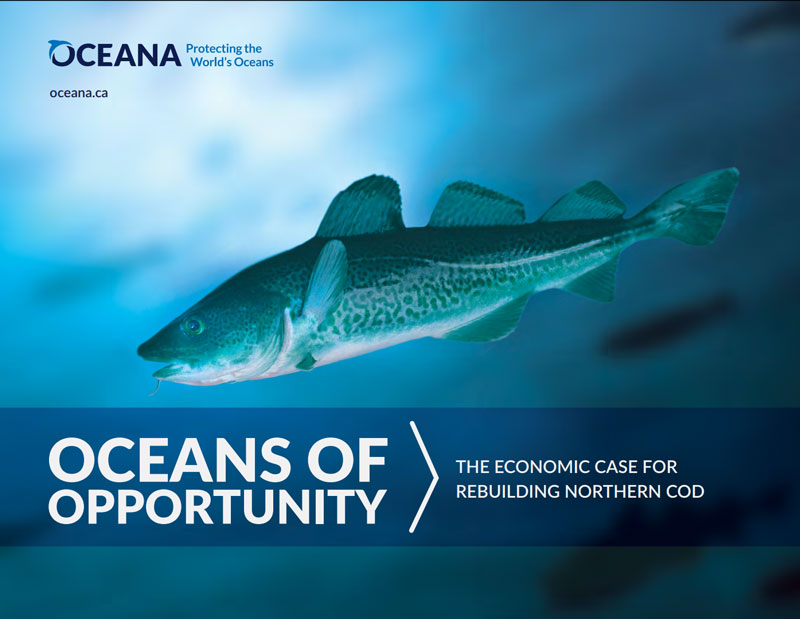
Oceans of Opportunity: The economic case for rebuilding northern cod highlights that a rebuilt northern cod fishery could provide 16 times more jobs and have a net present value worth up to five times more than today. With low fishing pressure and favourable environmental conditions, the fishery could recover in as few as 11 years, supporting economic activities worth $233 million in today’s dollars.

A review of the fate of southern British Columbia coho salmon over time.

Coho salmon (Oncorhynchus kisutch) were once a thriving species in southern British Columbia, acting as a source of food, livelihood, and recreation. Research on the survival and status of coho salmon in British Columbia has been critical since an unprecedented moratorium on Interior Fraser River stocks was put in place in 1998, leading to its designation as an endangered species. Since then, no comprehensive literature review has been undertaken on coho salmon. The present paper outlines current publication trends since the early 1990s, covering research areas that include the management and regulation of wild-capture coho salmon fisheries, hatchery enhancement efforts, as well as the pertinent factors that resulted in low returns. A complementary analysis did reveal a progressive downward shift in the total publication records pertaining, but not limited to, coho salmon in British Columbia. This review process identifies future steps and guidelines that policy makers and fisheries managers should take into account to improve the conservation outlook of coho salmon. Emerging technologies such as the use of genomic identification tools, more consistent and thorough data gathering processes, as well as reformed hatchery rearing practices, have all been identified as decisive action items.
Culture as vector: agency for social-ecological systems change.

(book chapter in On Active Grounds) This book considers the themes of agency and time through the burgeoning, interdisciplinary field of the environmental humanities. Fourteen essays and a photo album cover topics such as environmental practices and history, temporal literacy, graphic novels, ecocinema, ecomusicology, animal studies, Indigeneity, wolf reintroduction, environmental history, green conservatism, and social-ecological systems change. The book also speaks to the growing concern regarding environmental issues in the aftermath of the 2015 Paris Climate Conference (COP21) and the election of Donald Trump in the United States. This collection is organized as a written and visual appeal to issues such as time (how much is left?) and agency (who is active? what can be done? what does and does not work?). It describes problems and suggests solutions. On Active Grounds is unique in its explicit and twinned emphasis on time and agency in the context of the Environmental Humanities and a requisite interdisciplinarity.